
PLC & HMI Programming
Programs written in-house for Allen-Bradley, Siemens and Schneider Electric, tested at FAT.
WETS AI engineers your control system from the process up. Our in-house team, led by a Texas-licensed Professional Engineer, defines the control narrative and process parameters, supports HAZOP and SIL identification, and produces the process flow diagram and panel drawings that our Houston shop then builds, programs and tests.
Many panel problems start before the first wire is pulled: a sequence nobody wrote down, an interlock that was assumed, a setpoint that changed in a meeting. Our engineering work closes those gaps before the build begins.
We start with how your process should run and turn it into documents that the panel, the program and your operators can all follow.

Every engineered panel moves through the same eight steps, so nothing is assumed and everything is tested.
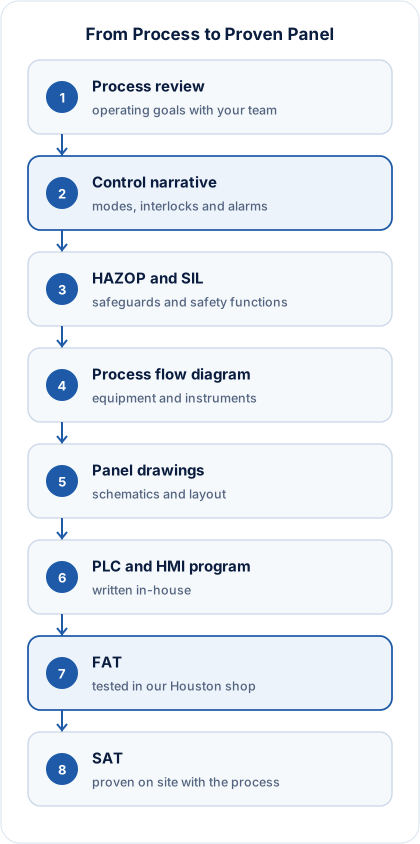
A control narrative describes in plain language how the system should behave: how it starts and stops, what happens in each mode, which conditions must be true before equipment runs, and what the operator sees when something goes wrong.
It becomes the reference for the drawings, the PLC program, the HMI screens and the test procedure. When everyone works from the same narrative, the factory acceptance test checks the panel against what was agreed, not against memory.
A HAZOP (hazard and operability study) is a structured team review of what could go wrong in a process, such as too much flow, no flow or high temperature, and how the system should respond. Our engineers take part so that every agreed safeguard is carried into the control design.
SIL identification looks at the safety functions that protect against the most serious hazards and sets how much risk reduction each one has to provide. The results decide which functions need dedicated safety instrumentation and how they are kept separate from normal control.
Both feed straight into the panel: which trips are hardwired, which alarms the operator sees, and how safety functions are tested.
When the engineer who wrote the narrative sits next to the shop that builds the panel, questions get answered in minutes and design intent survives the build. Changes are tracked in one place, the program matches the drawings, and the people who test the panel know why every function exists.
If you already have an engineering firm, we can also work from their documents. See build-to-print assembly.

Yes. We start with the process and your operating goals, write the control narrative with you, and develop the drawings from there.
Engineering is led by Keyur Gorji, P.E., founder of WETS AI and a Texas-licensed Professional Engineer with over 25 years of experience in industrial controls.
Yes. We review what you have, point out any gaps that affect the controls, and build on your documents rather than starting over.
Yes. The same team handles PLC and HMI programming, panel assembly, and testing at FAT and SAT.
Allen-Bradley, Siemens and Schneider Electric. We follow your plant standard when you have one.
Programs written in-house for Allen-Bradley, Siemens and Schneider Electric, tested at FAT.
The 13 checks every panel passes, plus witnessed FAT and SAT on site.
What the UL 508A label covers, how SCCR is set, and what we check before a panel is labeled.
Tell us about your process. We will suggest the right starting point, whether that is a control narrative, a full design or a review of your drawings.