
01
Check the build
Wiring, ratings and marking are checked against the drawings.

WETS AI builds pump and lift station control panels in Houston, Texas, for water, wastewater and process applications. Our duplex and triplex panels handle level control, pump alternation and alarms, are built to UL 508A in outdoor-rated enclosures, and are fully tested before they ship.
A pump panel starts and stops pumps based on level or pressure, shares the work between them, and raises an alarm when something is wrong. Many run unattended for months, so they have to be simple to read and hard to confuse.

Floats and a level transducer in the wet well tell the panel when to start and stop each pump.
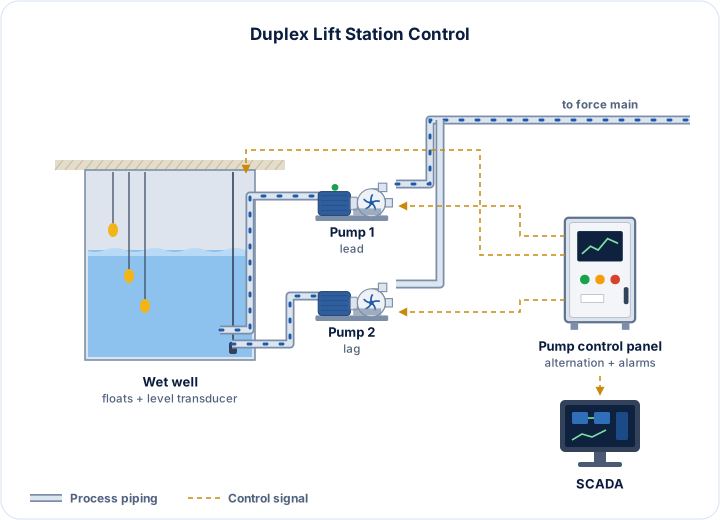
The number of pumps sets the control logic, the panel size and how the station handles peak flow.
| Arrangement | How it runs | Typical use |
|---|---|---|
| Simplex | One pump, no standby | Small, non-critical duty |
| Duplex | Two pumps alternate; the second starts on high level or if the first fails | Most lift stations and booster stations |
| Triplex | Three pumps share duty, with more capacity for peak flows | Larger stations with wide flow swings |
Your engineer usually sets the arrangement. We build the panel to match it and agree the alternation logic with you.
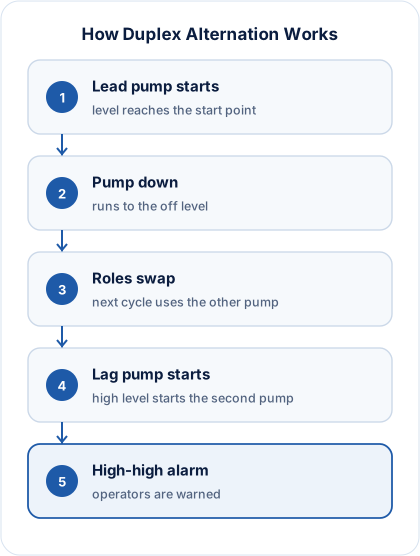
Alternation spreads run hours across both pumps, so one pump is not left idle while the other wears out.
Float switches are simple and easy to replace. A level transducer gives a continuous reading, adjustable setpoints and trending. Many stations use a transducer for normal control with backup floats for high-level alarm and pump-on, so the station keeps working if the transducer fails.
We wire the level controls your design calls for, and test every level point, start, stop and alarm before the panel ships.
Wiring, ratings and marking are checked against the drawings.
Supply, phase rotation and control power are verified.
Every level input is simulated to prove starts, stops and alarms.
Lead and lag swap, standby start and fail-over are tested.
Yes. We build simplex, duplex and triplex panels with lead, lag and standby alternation.
Yes. Most lift station panels are built in NEMA 3R, 4 or 4X enclosures for outdoor installation.
Yes. We build pump panels with VFDs for variable flow, or with full-voltage or soft starters.
Yes. We provide alarm outputs or PLC communications for remote monitoring.
About 16 weeks on average from order to shipment. The real figure depends on panel size and on component lead times, so we confirm a schedule with every quotation.
Aeration, filtration, ion exchange, PFAS, RO and chemical dosing control panels.
Full-voltage and soft starters, overloads and SCCR for every motor branch.
Drives, bypass, reactors and cooling for pumps, blowers and fans.
Send the pump data, level control method and site conditions. We will quote the complete panel.