
01
Agree the terminal list
Terminal numbers and wire numbers are confirmed from your drawings.

WETS AI builds junction boxes and terminal panels in Houston that bring field wiring together in one clean, marked place. Every terminal and wire is marked to your drawings, so installers and maintenance teams can find any circuit fast, and repeat orders are built identically.
Junction boxes collect cables from instruments and equipment in the field and connect them to multicore cables back to the control panel. Marshalling panels sort those signals into the order the control system expects.

Field devices land in a nearby junction box, so one multicore cable runs back to the panel instead of dozens of single cables.
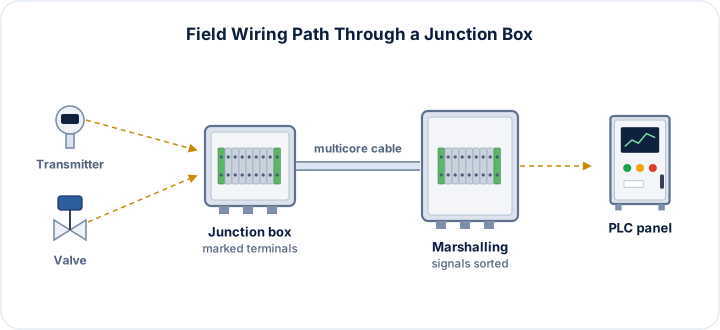
A junction box is often opened years after installation, in bad light, by someone who did not build it. Clear terminal numbers and marked wires that match the drawings turn a long search into a quick check.
We mark every wire in-house to your wire numbers and check each connection point to point before the box ships.
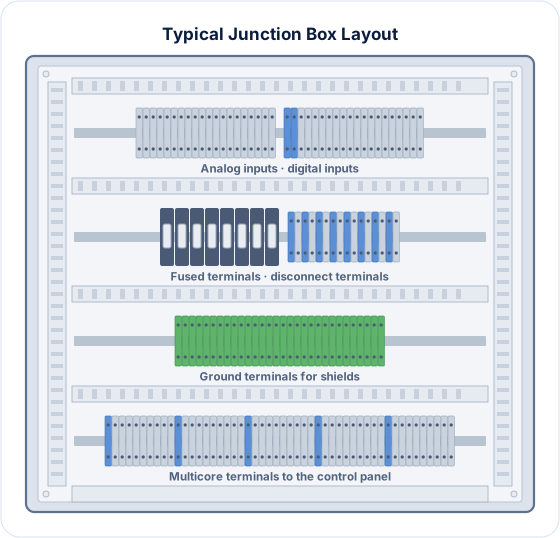
Terminal choice decides how easy the box is to test and maintain years from now.
The right mix lets a technician isolate one loop without touching the rest.
| Terminal type | Used for |
|---|---|
| Feed-through terminal | General signal and power connections |
| Fused terminal | Protecting individual field circuits, so one fault does not affect others |
| Disconnect terminal | Isolating a loop for testing without removing wires |
| Ground terminal | Cable shields and protective earth connections |
We follow the terminal types on your drawings, or recommend them from the signal list.
Terminal numbers and wire numbers are confirmed from your drawings.
Terminals, ground bars and entries are fitted to the layout.
Every wire is marked and terminated to the drawings.
Point-to-point and ground continuity checks are completed and recorded.
Yes. Repeat boxes are built from the same released drawings, so every unit matches.
Yes. We build in NEMA 3R, 4 and 4X enclosures for outdoor, wet and corrosive locations.
Yes. Every wire is marked in-house to match your drawings and wire numbers.
Yes. We fit gland plates and entries to your drawing so the box is ready for installation.
About 16 weeks on average from order to shipment. The real figure depends on panel size and on component lead times, so we confirm a schedule with every quotation.
Controllers, I/O, networks and power, built to UL 508A and tested point by point.
Your drawings and bill of materials, built, marked and tested to UL 508A.
Disconnects, breakers, control transformers and 24 VDC supplies.
Send the drawings and quantities. We will quote single units or repeat batches.